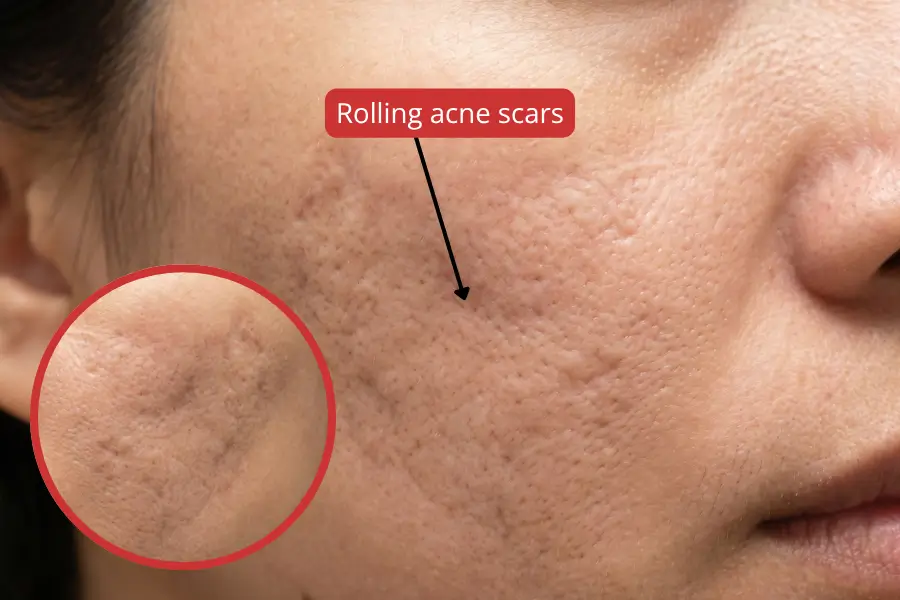
Rolling acne scars can remain visible long after active acne has resolved. The acne is gone. The inflammation has settled. The skin is finally calm — and yet, in certain light, the face still looks uneven, shadowed, almost collapsed in patches. No active breakout in sight, but residual textural changes may remain visible on affected areas of the skin. As the Australasian College of Dermatologists notes, acne scars are permanent textural changes and indentations that occur on the skin as a result of severe acne — and treating acne scarring generally requires a different clinical approach from treating active acne.
What rolling acne scars actually are
Acne scars aren’t a single thing, and this is where a lot of people go wrong before they’ve even started. This distinction is often overlooked.
The term gets used as a catch-all, but ice pick, boxcar, and rolling scars each have a different structure — and a different treatment response. Using the wrong approach for the wrong scar type doesn’t just slow things down. Treatment selection is influenced by scar type, and some approaches may be more suitable than others. It can set the skin back.
Rolling scars are broad, shallow depressions with sloping edges. The skin looks wavy, uneven, almost like it’s been pressed down from below — because in a sense, it has been. They form when fibrous bands of tissue develop between the skin surface and the subcutaneous layer underneath, pulling the skin downward. That tethering is the defining feature. It’s also what makes rolling scars uniquely difficult to treat It contributes to why rolling scars may require different treatment approaches.
For context: ice pick scars are narrow, deep punctures. Boxcar scars have sharply defined, punched-out edges. Rolling scars don’t have that kind of definition — they blend at the edges, which is partly why they’re so hard to photograph but so obvious in natural or side lighting. The cheeks, temples, and jawline tend to bear the worst of it, because that’s where cystic and inflammatory acne usually concentrates.
Getting the type right before starting any treatment isn’t a formality. It can influence treatment planning and expectations.
What causes rolling acne scars
The short version: rolling scars develop as part of the skin’s healing response following inflammatory acne.
Rolling scars are a direct consequence of inflammatory acne — particularly cystic and nodular breakouts that go deep enough to damage the lower layers of the skin. During repair, the body sometimes lays down fibrous collagen bands rather than rebuilding the tissue smoothly. Those bands anchor the surface of the skin to the subcutaneous layer below, pulling it inward. The dip you see is that tethering made visible.
A few things make it more likely to happen. Leaving inflammatory acne untreated for extended periods is one — prolonged inflammation may increase the likelihood of scarring. Picking or squeezing active lesions is another, and probably the most preventable factor. It drives inflammation deeper and may increase the likelihood of structural scarring. And then there’s genetics, which is less controllable — some people scar more readily than others regardless of how carefully they’ve managed their skin.
This is partly why clinicians often recommend early assessment and management of inflammatory acne. As Healthdirect Australia advises, untreated acne can leave permanent skin scars — and prevention is generally more effective before permanent scarring develops.
Why rolling acne scars don’t respond to skincare alone
Here’s the core issue: rolling scars sit below the dermal-epidermal junction. Topical products primarily affect the upper layers of the skin. Topical products may have limited effect on deeper structural changes associated with rolling scars.
Retinoids, vitamin C, niacinamide — none of this is useless. These actives have a genuine supporting role in any scar management protocol. They improve overall skin texture, help fade the post-inflammatory discolouration that often surrounds scarred areas, and keep the skin in better condition during and between clinical treatments. These products may support overall skin health but do not directly address all aspects of scar structure.
Clinical procedures are commonly considered for rolling scars — and usually more than one session of them.
Treatment options for rolling acne scars
What works varies considerably from person to person. Scar depth, skin type, skin tone, budget, and individual healing response all shape the outcome. Anyone offering a single universal answer isn’t accounting for enough variables. That said, the same treatment options come up consistently in clinical practice for rolling scars specifically.
Subcision
Subcision is a commonly used first-line option for rolling acne scars, particularly where fibrous tethering is the primary structural issue. A fine needle is inserted beneath the scar and used to physically sever the fibrous bands responsible for the downward tethering. Once those bands are released, the skin lifts. The mechanism is well-established, though results depend heavily on operator skill and the depth and extent of the scarring.
Expect bruising and some swelling for several days after each session. It is typically done under local anaesthetic. A course of multiple sessions is generally required — your practitioner will advise on the number based on your assessment. On its own, subcision addresses the tethering. Combination treatment approaches are commonly used in clinical practice.
Microneedling
Microneedling works differently. It doesn’t release anything — it stimulates. Controlled micro-injuries to the skin trigger a collagen production response, and that gradual remodelling improves both scar depth and overall skin texture over a course of treatments. It is reasonably well-tolerated across skin types and supported by clinical evidence for rolling and boxcar scars.
The catch is that results build slowly. Multiple sessions are typically needed, and the skin continues to improve for months after the final treatment as newly produced collagen matures. Because microneedling doesn’t address the tethering directly, it may be more suitable in some cases when used alongside subcision rather than as the sole intervention.
Radiofrequency microneedling
RF microneedling is essentially microneedling with an added layer of thermal energy delivered through the needles directly into the dermis. That combination — mechanical injury plus radiofrequency heat — drives a more intense collagen and elastin response than standard microneedling alone. It has an established evidence base for acne scarring, and for moderate-to-severe rolling scars it is increasingly used as a commonly used modality.
It costs more than standard microneedling. It also typically requires fewer sessions to reach comparable or better results. Downtime varies depending on the intensity of treatment and individual healing response.
Dermal fillers
Fillers take a different approach entirely. Rather than stimulating the skin to rebuild from within, hyaluronic acid is injected directly beneath the scar depression to physically lift the tissue from below. Improvement may be visible shortly after treatment — which is what makes it appealing, particularly for patients who want visible improvement while longer-term remodelling treatments are working.
The limitation is that fillers are temporary. Results vary between individuals, and retreatment is generally needed — often within six to eighteen months as the filler is gradually absorbed. For that reason, most practitioners use fillers as part of a broader protocol rather than a standalone solution — a way to improve appearance in the near term while other treatments are being considered or undertaken.
Laser resurfacing
Fractional laser — both ablative and non-ablative — stimulates collagen remodelling and resurfaces the skin. It is most effective for shallow rolling scars and post-inflammatory pigmentation, and less so for deeply tethered scars where the structural problem hasn’t been addressed first.
Ablative lasers produce more significant improvement per session but come with more downtime. Skin tone matters here more than with some other modalities — certain laser wavelengths carry a higher risk of post-inflammatory hyperpigmentation in medium to darker skin tones. The Therapeutic Goods Administration (TGA) also notes that patients on or recently completing isotretinoin courses require a treatment pause before laser procedures, which is an important consideration for anyone managing both active acne and scarring simultaneously. These are conversations to have with the treating practitioner before any decision is made.
Skincare that supports scar treatment
Clinical treatments address the structure. Skincare addresses everything around it.
Tretinoin or adapalene used consistently over months have a documented effect on skin cell turnover and post-acne pigmentation — they’re not doing nothing. Vitamin C supports collagen synthesis and helps fade discolouration in the skin surrounding scarred areas. Niacinamide keeps redness and sebum in check. And Consistent SPF use is generally recommended — UV exposure slows scar remodelling and worsens pigmentation in a way that’s genuinely hard to reverse.
These measures are often used alongside clinical treatment approaches. Used correctly, it may support overall treatment goals.
Are rolling acne scars permanent?
Rolling scars are generally considered long-term structural changes to the skin. The fibrous tethering that causes them doesn’t loosen or dissolve on its own — unlike post-inflammatory hyperpigmentation, which fades over months, the structural component of rolling scars tends to persist over time. It may become slightly less visible as the skin changes with age.
With the right treatment, improvement may be possible for some patients. Complete elimination isn’t always realistic — particularly for deep or longstanding scars. The degree of improvement varies significantly depending on scar depth, how well the chosen treatments are matched to the presentation, and how the individual’s skin responds over time. A qualified practitioner can give a more realistic indication after assessing your specific presentation.
How to access acne scar treatment in Australia
Access pathways to acne scar treatment vary depending on location, practitioner availability, and individual circumstances. Delays in assessment may be a consideration for some patients.
Telehealth may provide an additional access pathway for those who face barriers to in-person consultations. Online services now connect patients with AHPRA-registered practitioners through remote consultation where clinically appropriate — one option that may be considered for anyone managing both active acne and rolling scars, which is a common combination. The process is straightforward: complete a skin questionnaire, submit photos of the affected areas, attend a short online consultation, and receive assessment and management recommendations based on the information provided. Acne Express is one such service operating in Australia. For scarring specifically, the conversation takes longer — it involves working out which modalities suit your scar type, skin tone, and budget, and what a realistic treatment timeline looks like.
The bottom line
Topical products may have limited impact on the structural features of rolling scars. Treatment options vary depending on scar type and individual presentation — subcision, microneedling, RF microneedling, fillers, or a combination, depending on what the assessment shows. Individual response varies, and a qualified practitioner can provide treatment recommendations based on your specific scar type, skin tone, and clinical presentation.
If you’ve been trying to manage acne scarring without clinical input, a telehealth consultation may be one option to consider. Services like Acne Express offer online assessments with AHPRA-registered practitioners across Australia.
FAQs
Rolling acne scars commonly develop when inflammatory acne affects deeper layers of the skin, because the inflammatory acne you had was deep enough to damage the lower layers of skin, setting off an irregular collagen response during healing. Cystic or nodular acne, breakouts that went untreated for extended periods, or lesions that were repeatedly disturbed all may increase the likelihood . That said — scarring can develop even when acne has been carefully managed. It isn’t always connected to anything the person did or didn’t do.
They’re mid-depth — shallower than ice pick scars, which go deep into the dermis, but deeper than surface-level pigmentation. Depth is one factor, alongside structural tethering beneath the skin. it’s the fibrous tethering that connects the skin surface to the subcutaneous layer below. That structural component is what may limit the effectiveness of topical treatment alone, regardless of how potent the product is.
Disclaimer: This article is for general informational purposes only and does not constitute medical advice. Individual results vary. Consult a registered healthcare professional before beginning any acne scar treatment. All clinical treatments mentioned require appropriate assessment by a qualified practitioner.