You may be researching dermatologist vs esthetician for acne — because your skin has been doing this for months and you’re running out of patience. The facial didn’t fix it. The new cleanser didn’t fix it. The expensive serum that had 4,000 five-star reviews didn’t fix it either.
So now you’re trying to figure out if you’ve been seeing the wrong person entirely.
Honestly? You might have been. In some cases, a different type of care may be more appropriate.
Estheticians Are Good. Just Not at Everything.
Let’s not be unfair here. Estheticians know skin. They’re licensed, trained, and a lot of them are genuinely excellent at what they do. Walk into a good medi-aesthetic clinic and you’ll find someone who can read your skin better than most GPs can provide detailed cosmetic skin assessments within their scope of practice.
For acne, they’ve got a decent toolkit. Deep-pore facials. Extractions for blackheads and surface congestion. Lower-strength chemical peels. LED therapy. Hydration treatments when your skin barrier is shot. If your acne is the mild kind — a few blemishes before your period, some congestion around your nose, the occasional flare when you’ve been stressed or travelling — consistent sessions with a skilled esthetician may help improve mild acne and overall skin appearance. can genuinely improve things. Fewer flares. Less build-up. Calmer skin overall. Real results.
The problem isn’t what they can do. It’s what they can’t. It is also important to understand the limits of their scope of practice.
The Part Nobody Explains Clearly Enough
Estheticians aren’t doctors. They can’t diagnose a skin condition, they can’t prescribe anything, and legally they can’t treat something that falls under a medical classification. For a chunk of people reading this, that’s a significant limitation — because the acne you’re dealing with isn’t really a skincare problem. This may be a limitation in cases where acne has underlying medical or hormonal factors.
Think about what your breakouts are actually doing. Are they tracking your cycle? Sitting in the same spots on your jawline every single month? Painful to touch? Coming back no matter how clean your routine is? That’s not congestion. These patterns may indicate underlying hormonal or inflammatory contributors — and no amount of cleansing or exfoliation addresses what’s going on inside.
There’s also the risk side of things. Estheticians who attempt extractions or aggressive treatments on inflamed or cystic lesions — without medical oversight — may worsen inflammation or increase the risk of complications in some cases. Not because they’re incompetent, but because they’re using the wrong tool for the job potentially increasing inflammation or contributing to skin damage if not appropriately managed.
Deeper forms of acne may require medical assessment and treatment beyond surface-level care.
What a Dermatologist Actually Changes
A dermatologist is a medical doctor. Not a skincare professional with extra training — an actual specialist physician who spent years studying everything that can go wrong with skin at a clinical level. According to the Australasian College of Dermatologists, dermatologists complete a minimum of twelve years of medical training and specialist study before practising independently. The scope of practice differs significantly.
They assess both clinical history and skin presentation. It’s not just "what does your skin look like today" — it’s your full history. Your hormones. The pattern of your breakouts. What you’ve already tried and why it didn’t work. They’re building a picture, not just treating a symptom.
From there: a clinical diagnosis, prescription topical treatments, oral medications when clinically indicated — determined entirely by your treating clinician based on your individual presentation — investigation into whether something systemic is driving things, and clinical procedures for what’s already happened to your skin. In-clinic treatments for active or severe lesions, stronger peels, laser for scarring — all determined by your treating clinician based on your specific situation.
If you’ve got cystic acne, hormonal acne, or you’ve been dealing with breakouts for the better part of a year with nothing to show for it but frustration and fading marks — consulting a dermatologist may be appropriate. It’s just the appropriate level of care.
The Access Problem Nobody Talks About Enough
Here’s the thing that may contribute to delays in accessing care. In Australia, getting in front of a dermatologist takes time. We’re talking three to six months for a lot of people, longer in regional areas, and a GP referral usually required before you can even book.
Meanwhile your skin is doing what it’s doing. Breakouts keep coming. Marks keep forming. The early assessment may help reduce the risk of long-term skin changes while you wait for an appointment. Healthdirect Australia notes that early treatment of acne reduces the risk of lasting skin damage — which is exactly why waiting months to access care is more than just an inconvenience.
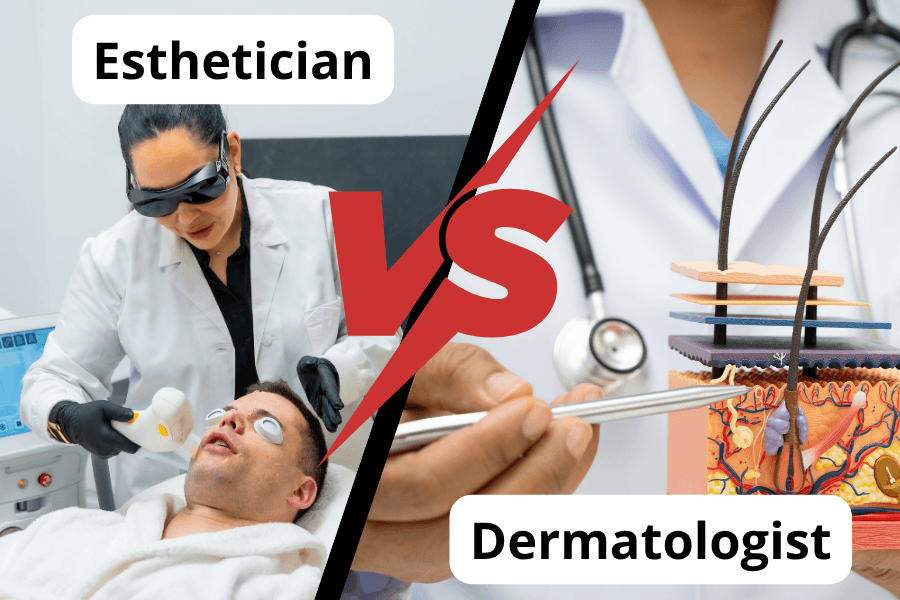
Esthetician vs Dermatologist: Quick Comparison
Esthetician |
Dermatologist |
|
Qualifications |
Licensed beauty/skin therapist |
Medical doctor (specialist) |
Acne suited for |
Mild, surface-level, occasional |
Moderate, severe, hormonal, cystic |
Can prescribe? |
No |
Yes |
Treatments offered |
Facials, peels, extractions, LED |
Topical Rx, oral Rx, clinical procedures |
Referral required? |
No |
Usually yes (in Australia) |
Wait time |
Minimal |
Weeks to months |
Cost |
$80–$200 per session |
$150–$400+ per consultation |
Acne Scars: Where It Gets Complicated
Both professionals have a role here, just very different ones.
Estheticians can help with early damage. Microneedling, superficial peels, LED — if the scarring is fresh, mild, mostly redness and some slight texture, cosmetic treatments done consistently over time can improve things noticeably. That’s legitimate. That’s worth doing if the damage is at that level.
But actual acne scars — the ice pick pits, the boxcar depressions, the rolling texture, the raised hypertrophic scars — those are structural. They’re inside the dermis, not sitting on top of it. Superficial treatments may have limited effectiveness for deeper structural scarring. Treatment may involve medical or procedural approaches determined by a dermatologist.
If you’re already seeing scarring and you’re tempted to just book a course of facials and hope for the best — get a medical opinion first. Spending two years on treatments that weren’t designed for your problem may not provide the desired outcomes if not appropriately matched to the condition.
Can an Esthetician Treat Cystic Acne?
In most cases, cystic acne requires medical assessment. Cosmetic treatments alone are generally not sufficient for cystic acne.
A cyst is not a blocked pore. It’s not something sitting near the surface waiting to be extracted. It’s a deep, inflamed, fluid-filled lesion inside the dermis — and handling it incorrectly causes the kind of damage that sticks around. Ruptured internally, the infection spreads into surrounding tissue. The inflammation deepens. This may increase the risk of scarring if not appropriately managed.
Cystic acne is a medical problem and it needs a medical response. A clinician will assess your individual presentation and determine the most appropriate course of treatment — which may include prescription topical or oral therapies based on your specific circumstances. The right clinical treatment, prescribed and monitored by a qualified professional, may help reduce the frequency and severity of cystic breakouts over time. Compare that to cosmetic treatment that was never designed to work on something that deep, and a medical assessment may be appropriate in these situations.
An additional option to consider
There’s a gap between "the esthetician isn’t enough" and "I can’t get a dermatology appointment until next March" — and a lot of Australians are stuck in it without realising there’s another option.
Telehealth. Specifically, platforms like Acne Express that provide access to qualified clinicians online. In many cases, telehealth consultations can be accessed without a referral and completed remotely. You consult directly with a clinician. If a prescription is clinically appropriate for your individual situation, it is issued and dispensed through the platform.
Getting acne treatment without a GP referral in Australia previously involved limited options for some patients. For people in regional areas especially, specialist access was — and still is — genuinely limited. As the Better Health Channel points out, seeing a doctor early for persistent acne is strongly recommended to prevent scarring and long-term skin damage. Telehealth has expanded access to care, particularly for those in regional areas.
So — Dermatologist or Esthetician?
See an esthetician if your skin is generally manageable, your breakouts are mild and mostly surface-level, and you want professional support alongside a routine that’s already working reasonably well.
See a dermatologist — or a qualified online clinician — if your acne is moderate to severe, if it’s cystic or hormonal, if six to eight weeks of over-the-counter treatment has done nothing, if you’re seeing scarring or marks that aren’t fading, or if you need prescription-strength treatment to actually make progress.
Estheticians are good at what they do. But "good at what they do" has limits — and when acne is a medical problem, cosmetic treatment is working on the wrong level. Early assessment may help guide appropriate management.
FAQs
A calming facial during a bad flare isn’t useless — it can reduce surface inflammation and make the skin feel more manageable. But hormonal acne is being driven by what’s happening inside your body. Androgen fluctuations, cycle patterns, conditions like PCOS — cosmetic treatment simply doesn’t reach any of that. A medical assessment may be appropriate and a treatment plan determined by a qualified clinician to manage it properly.
A dermatologist is a specialist doctor. They diagnose, prescribe, and treat skin conditions medically. An esthetician is a licensed beauty therapist providing cosmetic skin care. The training is different, the legal scope is different, and what each of them is equipped to actually treat involve different scopes of practice.
For genuinely mild, infrequent breakouts, probably yes — good skincare and the occasional esthetician visit might be all you need. But once your acne is recurring predictably, spreading, or starting to leave any kind of mark, earlier intervention may be beneficial. Scarring that forms while you’re still deciding whether to take it seriously is a lot harder to address than acne that gets treated before it reaches that point.
Yes. Telehealth platforms like Acne Express let you consult directly with a qualified clinician — no referral, no waitlist. If prescription treatment is clinically appropriate for your individual presentation, it is managed through the platform. For anyone who can’t access in-person dermatology quickly — or just doesn’t want to wait months — it is one option for accessing clinician-led care.
A few things to watch for: breakouts that are painful or sit deep under the skin, the same spots flaring month after month regardless of your routine, clustering along the jawline and chin, marks or scars that aren’t fading, or no meaningful response to over-the-counter products after six to eight weeks. Any one of those is a reasonable signal that a clinician — not a beauty therapist — may be appropriate based on your symptoms.
Disclaimer: This article is for general informational purposes only and does not constitute medical advice. Individual results will vary. Please consult a qualified healthcare professional for a diagnosis and personalised treatment plan suited to your individual needs and circumstances.