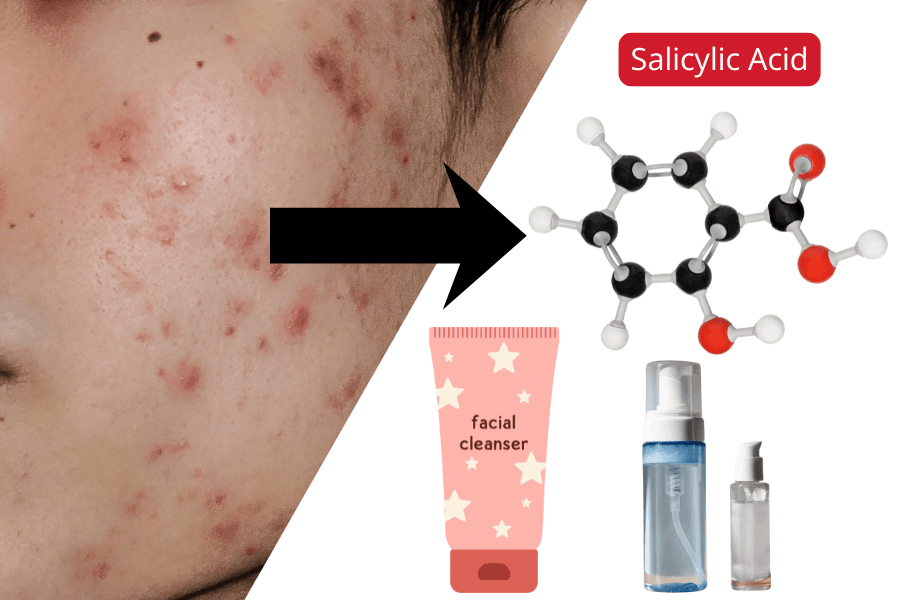
Finding the right salicylic acid cleanser for acne sounds straightforward. It really isn’t. What works brilliantly on one person’s skin can strip another’s bare, trigger more breakouts, and leave them worse off than when they started. Same ingredient on the label. Potentially different outcome.
This is an important consideration.
Skin type matters. Acne type matters. And where your breakouts show up? That can also influence how acne responds to treatment. A spot on your chin and a breakout on your back aren’t the same problem wearing different clothes. They have different triggers, different depths, and they respond to different things. So before you go by whatever got five stars or showed up on your feed three times this week, It is important to consider your individual skin type and acne pattern. What it actually does. Where it breaks out. This can be a more relevant starting point than relying solely on reviews.
How does a salicylic acid cleanser work?
It is helpful to understand what BHA means before anything else. Salicylic acid is a beta hydroxy acid — and the reason that matters is solubility. AHAs dissolve in water, so they exfoliate at the skin’s surface. Salicylic acid dissolves in oil. That means instead of working on top, it sinks into the pore lining — right where dead cells and sebum are accumulating within the pores and contributing to breakouts.
This buildup may persist without appropriate treatment. Over time it hardens into congestion, then blackheads, then inflamed spots. Salicylic acid loosens it before it gets to that stage. It also has a mild anti-inflammatory effect — it is not a standalone treatment for all types of acne, but enough to bring down some of the redness and swelling while a spot is still active.
Does salicylic acid cleanser remove acne? Here’s an honest answer: not entirely. If someone’s promising you that, they’re overselling it. What it does is go after one of the main reasons acne develops — clogged pores. For a broader overview of what causes acne and how different treatments work, Healthdirect Australia is a reliable place to start. Use it regularly and some people may experience fewer breakouts, and milder ones when they do happen. But give it weeks, not days. And if your acne has a hormonal or medical root cause, a cleanser alone isn’t going to sort that out.
Oily, acne-prone skin — this is where salicylic acid is commonly used
Shiny by mid-morning. Pores you can see without trying. Breakouts that just keep coming back. If that’s your skin, salicylic acid is probably one of the better things you can add to your routine.
The best salicylic acid cleanser for oily acne-prone skin is usually a gel or foaming formula — something with enough bite to actually cut through the oil rather than just moving it around. For concentration, 0.5% to 2% is where you want to be. That range is effective enough may provide noticeable improvement without being so aggressive that you’re potentially affecting your skin barrier while thinking you’re doing the right thing.
Twice daily is manageable for most oily skin types — but start once a day and build up. Increasing frequency too quickly may increase irritation.
Hormonal acne — may be more complex to manage
Jaw. Chin. Lower cheeks. Deep, painful spots that take forever to surface and even longer to heal. If that pattern sounds familiar, you’re most likely dealing with hormonal acne — and it’s one of the more frustrating types to manage.
The best salicylic acid cleanser for hormonal acne won’t address what’s driving the breakouts at a hormonal level. That’s a conversation to have with a doctor — or a specialist. The Australasian College of Dermatologists can help you find a qualified dermatologist if your acne needs clinical attention. But keeping your pores as clear as possible in the meantime may help reduce pore congestion.
It may be considered a supportive measure rather than a fix. Pair it with something your doctor recommends — niacinamide, a topical retinoid, or whatever suits your situation — and this may improve overall treatment outcomes.
Sensitive skin — it may still be suitable in some cases
If you’ve got sensitive skin, you’ve probably been told — or quietly assumed — that salicylic acid isn’t for you. Maybe you tried something once and your skin flared up. Maybe you’ve just been steering clear out of caution. Either way, it’s worth revisiting.
Sensitive skin and salicylic acid can coexist. It just takes a bit more thought about what you’re actually putting on your face. The best salicylic acid cleanser for sensitive acne-prone skin usually sits at the gentler end of the spectrum — 0.5% concentration rather than the maximum, fragrance-free because your skin doesn’t need that extra variable, and a formula that includes something to counterbalance the exfoliation. Centella asiatica and panthenol are good ones to look for. Aloe vera too. They don’t just make the product feel nicer — they may help reduce the likelihood of irritation while the salicylic acid gets on with its job.
Use it once in the evening to begin with. Give it a solid two weeks before you decide anything. If your skin is handling it — great, you can slowly build from there. If it’s not, back off. Forcing it through may worsen skin irritation.
Dry acne-prone skin — can be more challenging to manage
Tight and flaky in some areas, breaking out in others. It sounds contradictory, but dry acne-prone skin is genuinely common — and it needs a more careful approach than most people give it.
The main thing to avoid here is a foaming cleanser. Foaming formulas strip moisture, which sounds fine until you realise that stripped, dehydrated skin often compensates by producing more oil — which leads right back to more breakouts. which may worsen acne.
A salicylic acid cleanser for dry acne-prone skin should be cream or milk-based. Something that cleans without gutting your moisture levels. Look for glycerin or hyaluronic acid in the formula. And a salicylic acid face wash for dry acne-prone skin absolutely needs a moisturiser straight after — consistent moisturisation is recommended.
Teen acne — a simplified routine may be beneficial
Teenage skin tends to be oilier and more reactive, which actually makes it respond well to salicylic acid. The problem isn’t usually the ingredient — it’s everything else being layered on top of it.
A salicylic acid cleanser for teen acne works best as the anchor of a stripped-back routine. Cleanser. Moisturiser. SPF. That combination, used consistently, may be more effective than inconsistent routines that gets abandoned after two weeks because it’s too much to keep up with.
A salicylic acid face wash for acne used morning and night for six to eight solid weeks will tell you far more than switching between five different products ever could. Consistency is the unglamorous answer that may be effective.
Back acne and chest acne — the body needs attention too
Worth saying clearly: salicylic acid is not just for your face.
A salicylic acid cleanser for back acne or a salicylic acid cleanser for chest acne can work just as well as any targeted face wash — sometimes better, because body skin is thicker and generally more tolerant. Body acne is usually driven by sweat, friction, and blocked follicles that don’t get properly addressed in a rushed shower.
A BHA body wash used after exercise or at the end of the day may help improve symptoms over time. The one thing to get right is rinsing — leaving salicylic acid sitting on body skin longer than it can occur cause of irritation.
What about fungal acne?
Fungal acne — Malassezia folliculitis — looks enough like regular acne that people treat it the same way for months before recognising limited response. Because it won’t. It’s caused by yeast overgrowth on the skin, not bacteria, so standard bacterial acne treatments may be less effective.
A salicylic acid cleanser safe for fungal acne can help at the surface level — the exfoliation is useful — but it’s not going to treat the underlying issue. If your skin hasn’t responded to anything you’ve tried and the breakouts keep clustering in the same spots, fungal acne is worth raising with a professional. A clinical diagnosis may be helpful before continuing treatment.
Does salicylic acid help with scars and dark spots?
Does salicylic acid cleanser help acne scars? Sort of — but it depends on what kind of scars you mean.
For post-inflammatory hyperpigmentation — those flat dark marks that hang around after a spot heals — salicylic acid can help by speeding up cell turnover. A salicylic acid face wash for acne marks or a salicylic acid best face wash for acne and dark spots is a reasonable part of a broader routine, especially alongside something that targets pigmentation more directly, like vitamin C or azelaic acid.
For textural scarring — the pitted or raised kind — a cleanser alone may not be sufficient. That’s clinical territory: peels, microneedling, laser. Worth having that conversation with a dermatologist rather than relying on topical treatments that may not address deeper scarring.
Salicylic acid vs benzoyl peroxide cleanser for acne — which option may be more suitable?
This is one of the most common questions in acne skincare — and the answer isn’t really about which one is better. It’s about what your skin is actually doing.
Salicylic acid gets inside the pore and clears the blockage before a spot has a chance to form. Benzoyl peroxide doesn’t work that way. It goes after the bacteria — the kind that move in once a pore is already blocked and turn a minor congestion into something red, swollen, and painful. Two different mechanisms. Two different problems.
If your acne is mostly blackheads, whiteheads, and that general clogged feeling across your nose or chin — salicylic acid may be appropriate for this type of acne. Inflammatory acne with red, angry papules and pustules often needs the antibacterial action of benzoyl peroxide.
Some people do well alternating the two — morning and evening, or on different days. That can absolutely work. Just don’t use a salicylic acid vs benzoyl peroxide cleanser for acne approach where you’re mixing them in the same session. That combination may increase the risk of skin barrier irritation.
When should you use a salicylic acid cleanser?
Evening is commonly recommended for most people. Skin repairs itself overnight, and there’s no risk of heading straight out into sun exposure on freshly exfoliated skin. That said, plenty of salicylic acid cleansers are formulated for twice-daily use and work fine in the morning too — just follow with SPF.
When should you use a salicylic acid cleanser and when should you give it a rest? Signs of irritation may indicate a need to reduce use. Persistent tightness, sensitivity, or dryness are signs to dial back — once a day, or even every other day. Pushing through those signals doesn’t accelerate results. It just damages your barrier and may worsen irritation and sensitivity.
Side effects — what to expect and what to watch for
Some dryness, mild peeling, and a bit of redness in the first couple of weeks — mild side effects such as dryness or redness may occur initially. Your skin is adjusting to an active ingredient. regular moisturising may help support the skin barrier, stay consistent, and it generally settles within a fortnight.
What shouldn’t happen: burning that doesn’t subside, noticeable swelling, or any sign of an allergic reaction. If you experience any of that, stop using the product. Don’t push through it. The Therapeutic Goods Administration provides consumer guidance on how skincare ingredients are regulated in Australia — worth knowing before you start any new active. And if symptoms persist, speak to a healthcare professional.
Not sure where to start?
The right salicylic acid cleanser matters — but it’s one part of a bigger picture. At Acne Express, our practitioners assess your skin based on clinical information: type, acne pattern, current routine, lifestyle factors. Then they develop a plan tailored to your individual needs, based on your individual circumstances. You can learn more about online consultation options and determine whether they are suitable for your needs.
Disclaimer: This article is for general informational purposes only and does not constitute medical advice. For a diagnosis or personalised treatment plan, please consult a qualified healthcare professional.