Ice pick scars vs boxcar scars—if you’ve been down the Google rabbit hole at 2am trying to work out what’s happening with your face, you’ve probably seen these terms thrown around. The difference matters more than you’d think. These scars don’t just look different; they need completely different treatments. Mix them up and you’re basically burning money on stuff that won’t work.
Good news though: both can improve. You just need someone who actually knows their stuff to look at your skin and identify what you’re dealing with, then use treatments that target those specific scars. Whether that’s a regular dermatologist appointment or an online thing through Acne Express, proper assessment saves you years of expensive experimentation. Let’s get into what these scars actually are.
What are atrophic acne scars?
Atrophic scars are the indented ones—they sit below your normal skin level instead of being raised. They happen when inflammatory acne damages the collagen in your skin while it’s trying to heal. When bad acne creates inflammation deep down, your body tries to fix things but sometimes doesn’t make enough collagen to fill everything back in. You end up with a dent.
Unlike those dark marks that fade over months (post-inflammatory hyperpigmentation), atrophic scars are permanent changes to your skin’s structure. They’re not budging without intervention.
Three main types exist:
- Ice pick scars: Deep, narrow holes
- Boxcar scars: Wider dents with sharp edges
- Rolling scars: Wavy indents (we’re skipping these for now)
What are ice pick scars?
How ice pick scars look
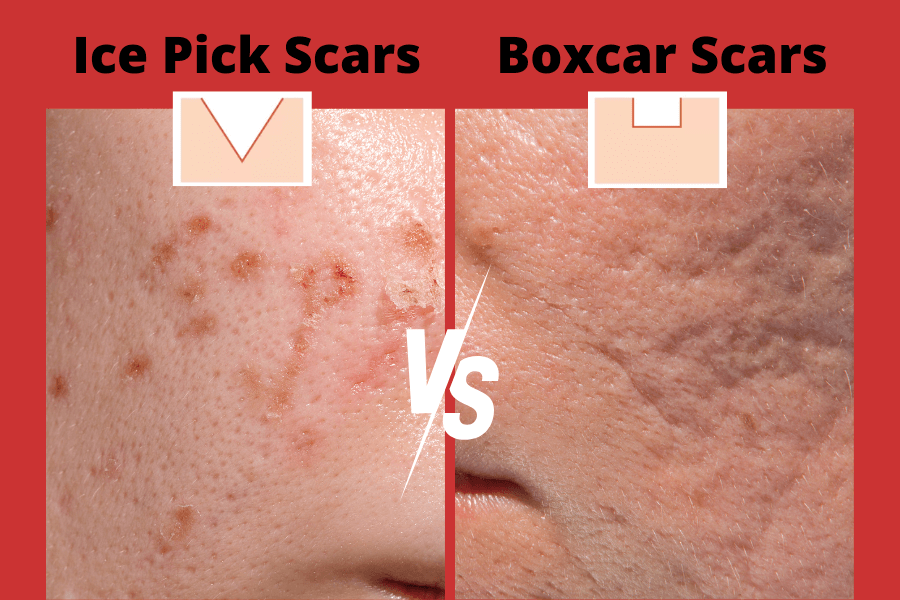
They look exactly like what the name suggests—someone’s taken something sharp and narrow and poked holes in your skin. Deep, narrow tunnels going down into the dermis. Dermatologists call them "V-shaped" because they start wider at the top and get narrower going down.
Most are under 2mm across, which sounds tiny. But their depth makes them stupidly noticeable. Those steep walls create shadows that makeup can’t cover, especially under certain lights. Bathroom lighting at work? Good luck.
Common causes of ice pick scars
Severe inflammatory acne causes these, especially the deep cystic type that absolutely destroys tissue below the surface. When infection wrecks collagen and supporting structures way down there, healing can’t always fix everything. You’re stuck with these narrow, deep pits.
Waiting ages to treat severe acne makes this worse. Those massive, painful spots that hang around for months? Every day increases the chance of permanent damage. Picking or squeezing deep cystic acne also massively increases your odds—dermatologists really wish people got this before they start attacking their faces in the mirror.
Areas commonly affected
Ice pick scars usually show up on:
- Cheeks: Upper and middle parts get hit worst
- Temples: People forget about this area but it’s commonly affected
- Forehead: Especially if you had bad T-zone acne
What are boxcar scars?
How boxcar scars look
Boxcar scars are broader, round or oval dents with sharply defined edges going straight down. "U-shaped" fits better than V-shaped. They’re wider (usually 1.5-4mm across) and have a flat bottom instead of narrowing to a point.
The edges are really obvious—you can clearly see where the scarred bit ends and normal skin starts. Dermatologists split them into shallow (0.1-0.5mm deep) or deep (over 0.5mm). Shallow ones respond better to treatment, which makes sense.
Common causes of boxcar scars
Moderate to severe inflammatory acne creates these by destroying collagen across a wider area than ice pick scars. When inflammation wrecks supporting tissue in a broader zone, healing leaves these wider dents.
Getting breakouts repeatedly in the same spot really increases your chances. Each time inflammation hits that location, more collagen gets damaged, eventually leaving a broader, depressed area. Random fact: chickenpox scars form similarly, which is why they often look like boxcar acne scars.
Areas commonly affected
Boxcar scars typically appear on:
- Cheeks: Most common spot, especially lower cheeks
- Jawline: Where acne often keeps hitting the same areas
- Lower face: Basically anywhere inflammatory acne’s been persistent
Ice pick scars vs boxcar scars: key differences
Depth and shape
This is the main difference. Ice pick scars go deep—picture someone poking a thin tool into your skin. They extend way down despite having a tiny opening at the surface. Boxcar scars spread wider without going as deep, with that broad, flat bottom and steep sides.
Easy way to remember: ice pick scars are like wells (narrow and deep), boxcar scars are like craters (wide and shallow).
Severity and visibility
Both are visible, just differently. Ice pick scars create harsh shadows because they’re so deep and narrow—particularly bad under overhead fluorescent lights. Boxcar scars stand out because of their size and sharp edges, creating uneven texture that shows in pretty much any lighting.
Response to treatment
This is where knowing the difference becomes critical. Ice pick scars are notoriously stubborn. That narrow, deep structure resists most standard treatments. Surface stuff like peels or microneedling barely touches them—they can’t reach deep enough to do anything meaningful.
Boxcar scars, especially shallow ones, respond much better to treatments like laser resurfacing, microneedling, and peels. The wider surface area and shallower depth makes them accessible.
| Feature | Ice Pick Scars | Boxcar Scars |
Shape |
V-shaped, narrow |
U-shaped, broad |
Depth |
Very deep |
Shallow to moderately deep |
Width |
Usually < 2mm |
Typically 1.5-4mm |
Treatment difficulty |
Way harder |
Generally more responsive |
Common spots |
Cheeks, temples, forehead |
Cheeks, jawline, lower face |
Why identifying the correct scar type matters
Get the scar type wrong and you’ll get the treatment wrong—it’s that straightforward. Ice pick scars need specific, depth-focused stuff like TCA CROSS. Boxcar scars respond to broader resurfacing. Try using boxcar treatments on ice pick scars? You’ll see basically nothing while your money disappears.
Professional assessment stops this waste. Someone experienced examines your skin and identifies exactly which types you’ve got. Most people have multiple types mixed together, making expert guidance even more important.
Someone selling generic "acne scar treatment" without actually looking at your scars properly? Red flag. One-size-fits-all fails spectacularly with scarring.
Treatment options for ice pick scars
Chemical Reconstruction (TCA CROSS): This involves applying really high-concentration trichloroacetic acid directly into individual ice pick scars with a fine applicator. The acid stimulates collagen production from the bottom of the scar upward, gradually filling it over multiple sessions. Currently one of the most commonly recommended treatments specifically for ice pick scars because it tackles that depth issue. Needs precision though—definitely not something to try at home unless you’re keen on potential disasters.
Laser Treatments: Fractional lasers can help by creating controlled micro-injuries that kick-start collagen remodelling. Results vary heaps depending on how deep the scars go. Really deep ice pick scars often show limited improvement from laser alone and usually need combination approaches.
Microneedling (Limited Effectiveness): Pretty limited for ice pick scars, honestly. Works well for broader, shallower scars, but that narrow, deep structure means microneedles often can’t reach the scar base properly. Might provide minimal improvement in very shallow ice pick scars, but don’t expect much.
Treatment options for boxcar scars
Microneedling: Works quite well for shallow to moderate boxcar scars. Creates controlled micro-injuries that trigger collagen production, gradually raising the depressed floor and softening those sharp edges. Multiple sessions spaced weeks apart usually give best results.
Laser Resurfacing: Both ablative and non-ablative fractional lasers can significantly improve boxcar scars by resurfacing skin and stimulating deeper collagen remodelling. The broader surface area makes them way more accessible to laser treatment than ice pick scars.
Dermal Fillers (Temporary): Can temporarily raise the base of boxcar scars, creating smoother appearance. The catch? Temporary means temporary—fillers eventually break down, and your scar returns to how it looked. Some practitioners use fillers as part of broader strategies or for special events, but they’re not permanent fixes.
Can ice pick and boxcar scars occur together?
Yeah, absolutely. Actually pretty standard. Most people with acne scarring have multiple types—ice pick scars scattered across upper cheeks, boxcar scars on lower cheeks and jawline, maybe rolling scars mixed in.
This is exactly why professional assessment becomes essential. You need combination treatment plans addressing each type appropriately. A dermatologist might suggest TCA CROSS for ice pick scars, laser for boxcar scars, and subcision for rolling scars—everything tailored to your specific pattern instead of generic approaches.
At-home care vs professional treatment
Good skincare prevents scarring from getting worse and improves overall texture. However—and this is important—it can’t remove established ice pick or boxcar scars. Products with retinoids, vitamin C, niacinamide, and AHAs support skin health and might slightly improve very shallow scarring, but they won’t fill structural dents.
Daily sun protection is non-negotiable. UV exposure darkens scars, making them more visible, plus undermines any professional treatment results you’re paying for.
DIY scar treatments carry real risks people underestimate. High-concentration peels, aggressive at-home microneedling, or other intensive stuff done incorrectly can worsen scarring, cause infections, or create additional damage and pigmentation issues that weren’t there before.
Professional guidance ensures you’re getting treatments that are both safe and actually effective. Online consultations through Acne Express provide accessible expert assessment without needing in-person appointments—particularly useful if you’re regional or can’t easily get to dermatology clinics.
How online acne & scar consultations can help
Online dermatology has made professional scar assessment way more accessible across Australia. Acne Express connects you with medical professionals who evaluate scarring through photos and detailed questionnaires, then provide personalised recommendations.
Remote assessment can be effective, as experienced practitioners are often able to identify scar types and severity from clear photos.” You get professional diagnosis explaining exactly which types you’ve got, personalised treatment plans considering your specific pattern, skin type, budget, and goals, plus ongoing guidance without repeated clinic visits.
Some treatments can be prescribed and managed entirely online, while others (laser, TCA CROSS) need in-person clinic visits for the actual procedures. Even for procedural treatments though, that initial online consultation helps you understand options and what to expect before committing to anything.
For professional guidance and localised information, you can visit the Australian Government’s Healthdirect website or explore the specialised resources provided by the Australasian College of Dermatologists. Early intervention and accurate diagnosis are key to preventing permanent structural damage and achieving optimal skin health.
Frequently asked questions
Yeah, they’re permanent structural changes that won’t disappear on their own. However, treatments like TCA CROSS, fractional laser, and punch excision can significantly improve how they look. Complete removal is genuinely challenging, but substantial improvement is definitely achievable with appropriate treatment.
Generally, yes. Boxcar scars—especially shallow ones—respond better to conventional treatments like laser and microneedling because their broader, shallower structure is more accessible. Ice pick scars need more targeted, intensive treatments because of their narrow, deep nature, and often show more modest improvement even with aggressive treatment.
Assessment and planning can definitely happen online through services like Acne Express. Practitioners evaluate scarring remotely through photos and prescribe appropriate treatments where applicable. However, actual procedural treatments like laser, TCA CROSS, or subcision need in-person clinic visits. Online consultations help you understand options and get professional guidance without that initial clinic visit though.
Varies heaps depending on treatment and severity. Microneedling typically needs 3-6 sessions spaced 4-6 weeks apart before visible improvement. TCA CROSS often needs multiple sessions over several months. Laser treatments usually show gradual improvement over 3-6 months as collagen remodelling happens. Patience is genuinely essential—scar treatment is gradual, definitely not overnight.
Understanding the difference between ice pick and boxcar scars matters way more than you’d think— it’s basically the difference between treatments that are appropriate for your scar type and those that are unlikely to help. Ice pick scars are narrow and deep, needing really specific approaches. Boxcar scars are wider and shallower, responding better to standard resurfacing. Most people have both types mixed together, so you need a plan that addresses each one differently.
Real improvement happens, but there’s a right way to go about it. Get professional assessment first—someone who knows what they’re looking at needs to examine your skin and figure out exactly what you’re dealing with. Then you can pursue treatments that actually match your scar types. Skip the people selling "miracle cures for all acne scars" or pushing you toward dodgy DIY treatments that could genuinely make things worse.
Early assessment and proper guidance make all the difference—whether that’s traditional dermatology appointments or online consultations through Acne Express. Your scars didn’t appear in a week, and they won’t vanish in a week either. Improving them takes patience and the right strategy. But here’s what’s encouraging: with proper treatment and realistic expectations, many people see meaningful improvement over time. Just don’t believe anyone promising instant results.
Disclaimer: This article provides general educational information about acne scarring and isn’t meant to replace advice from your doctor. Acne scar treatments come with risks and benefits that need proper discussion with a qualified medical practitioner. Results differ from person to person, and no treatment can guarantee your scars will completely disappear. Always talk to a registered medical practitioner before starting any acne scar treatment.